pa·tience (noun)
1. the quality of being patient, as the bearing of provocation, annoyance, misfortune, or pain, without complaint, loss of temper, irritation, or the like.
2. an ability or willingness to suppress restlessness or annoyance when confronted with delay: to have patience with a slow learner.
3. quiet, steady perseverance; even-tempered care; diligence: to work with patience.
My most recent backpacking trip was in the company of a friend who's fairly new to this type of adventure. Though it has it's challenges, it's wonderful to turn someone on to the magic of nature. To witness that "Aha!" moment when they get it. The friend in question is fairly fit and game for most anything. Still, our group planned something a bit less challenging, just to be safe.
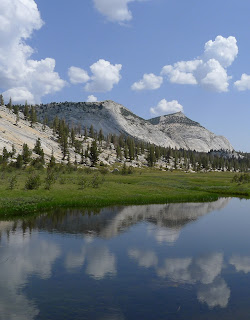
The hike in was an easy-moderate 4.6 miles. From here, we'd camp for two nights and venture out on more strenuous day hikes. We reached camp in the early afternoon, set up tents, filled our water bottles, and debated where to head for the remainder of the day. The friend, hearing of our destination, opted to hang out by the lake and read. The rest of us set off to climb the mountain looming over our lake. At the summit, we relaxed for awhile on top, enjoying the magic hour of light, before returning to camp. When we arrived, my friend greeted us excitedly, talking about the quiet, the birds, the smells, the light... she was beaming.
Later, she confessed that after our group had left, she sat staring at the lake. Lonely. Bored. She sat, and she stared, and she listened - for a very long while. And then she began to see - the way the light danced and shimmered across the surface of the lake, the way the fish caused ripples on its surface. And she heard - the song of birds, and the rustle of the wind through the trees. And she got it. She went from boredom - from seeing nothing - to the joy of awareness - seeing everything.
Gaining this awareness takes time. Time that we don't typically allow ourselves in the mad rush of everyday life. We live in a world where we can pretty much get anything we want
right when we want it. If we
need to talk to someone, we can call, text, or email them and get an instant response. If we need an answer, we can
pull out our iPhone and Google it, and have the answer in minutes. So, when we do have moments
where our patience is tested at work or at home, it’s easy to get
frustrated.
Impatience will not change anything for the better, it only makes us
feel worse. Impatience moves us to rush into the next moment without fully experiencing the present one. Pay attention when you find yourself blindly rushing forward. Take a few deep breaths. Focus. Wait. Waiting doesn't mean doing nothing, it means reflecting, relaxing, and seeing what develops. Cultivate patience and you'll not only reduce stress, but make wiser decisions.
Learn from the lesson of nature, of which we are all an integral part, and let everything unfold in its own time.
“Adopt the pace of nature: her secret is patience.” - Ralph Waldo Emerson
There
are many lessons to be learned from the natural world. Take trees, for example. Forests cover almost one third of
the land area of our planet. They help protect, sustain and improve
supplies of fresh water. They purify the air and convert
carbon dioxide, water, minerals and sunlight into nutrients and oxygen. And they support a wide variety of life, including many plants, insects, fungi, reptiles, birds, and mammals.
What life lessons can we learn from trees?

- Be flexible, so you don't break when a harsh wind blows.
- Cycles are a part of life.
- Leaves, though they can be small, are vital to the life of a tree. So value the little things.
- Even a mighty oak grows from a small acorn. Do not be intimidated by small beginnings.
- Sometimes you have to shed your old bark in order to grow.
- In
forests, individual trees support one another. How much support do you share with those around you?
Teamwork can accomplish much more than the sum of individual efforts,
often making the difference between success and failure.
- Your success and wisdom of life depends on how extensive your root system is, and how solid your principals are.
- Avoid people who would like to cut you down.
"Your deepest roots are in nature. No matter who you are, where you live, or what kind of life you lead, you remain irrevocably linked with the rest of creation." - Charles Cook
Even when we can't get "away" to the wilderness, it's still important to spend time in nature.
Particularly
for urbanite's, we need open green spaces to improve our physical and
psychological health, strengthen our communities, and make our cities
and neighborhoods more attractive places to live and work. Unfortunately,
too few Americans are able to enjoy these benefits. 80% of Americans
live in metropolitan areas, and many of these areas are severely lacking
in park space. Only 30% of Los Angeles residents live within walking
distance of a nearby park. Atlanta has no public green space larger than
one-third of a square mile. And low-income neighborhoods populated by
minorities and recent immigrants are especially short of park space.
Not only are green spaces are an essential component of a healthy community, but they're a great benefit for the whole environment. They filter pollutants and dust from the air, they provide shade and
lower temperatures in urban areas, and they even reduce erosion of soil
into our waterways.
Green spaces can come in many forms, and can be started by YOU -
- Plant a tree - It's one of the most simple and effective things you can do to improve your green space.
- Create a Community Green - These are shared open green spaces on the
inside of city blocks, created either when residents merge backyard
space or reclaim underutilized urban land such as vacant lots and
alleyways. Communities that create backyard commons have increased interaction with neighbors throughout the
planning and implementation process, which results in a stronger overall
sense of community.
- Apply to Install a Parklet - These mini sidewalk parks are popping up in many cities. Parklets are aesthetic enhancements to the streetscape,
providing an economical solution to the need for increased public open
space.
- Create a Park in Your City - This takes more work, but there are organizations like The Trust for Public Land that provides tools to help.
- Become an Urban Gardener - Besides making your food as "local" as possible, urban gardening provides all the other green space benefits.
This perfectly sums up what I feel after just returning from a week hiking in Yosemite National Park on the John Muir Trail -
"You didn't come into this world. You came out of it, like a wave from the ocean. You are not a stranger here." - Alan Watts
 Only one week, and I feel reborn, refreshed. And, I feel a deep gratitude for those that fought the good fight, and still are, to protect and preserve our wild spaces. This last was hit home strongly by a German friend who joined me on this trip. This is a guy I'd met trekking in Nepal 7 years prior. He's fortunate to be a tour guide and has spent a lot of time in majestic mountain landscapes all around the world. After a brief trip here in 2009, he was eager to come back for more, and set his sights on a 4-week hike of the legendary John Muir Trail. I joined him for the first few days and was inspired at seeing the California Sierras through his eyes. One observation he made really struck me - that in the Alps, or Himalayas, or in most other mountain ranges, you generally begin in a town or village, hike up a mountain, then descend back to another town. Not only that, but, particularly in the Alps, on many of the ridges you'll see gondolas, and lights, and roads snaking through all the valleys. But here, in the California Sierras, you can look as far as the eye can see, and walk for a couple days (or more) in any direction, and still be in wilderness. WOW!
And it's true. As we sat in the evenings, watching the light fade from the sky and be replaced by countless stars, I realized that I couldn't even detect a dim glow of some distant town anywhere on the horizon. Yes, this is rare I thought, and to the great credit of the founder's of our country's national park system. And countless others who have fought for their continuing preservation, against great odds. David vs. Goliath type battles.
Only one week, and I feel reborn, refreshed. And, I feel a deep gratitude for those that fought the good fight, and still are, to protect and preserve our wild spaces. This last was hit home strongly by a German friend who joined me on this trip. This is a guy I'd met trekking in Nepal 7 years prior. He's fortunate to be a tour guide and has spent a lot of time in majestic mountain landscapes all around the world. After a brief trip here in 2009, he was eager to come back for more, and set his sights on a 4-week hike of the legendary John Muir Trail. I joined him for the first few days and was inspired at seeing the California Sierras through his eyes. One observation he made really struck me - that in the Alps, or Himalayas, or in most other mountain ranges, you generally begin in a town or village, hike up a mountain, then descend back to another town. Not only that, but, particularly in the Alps, on many of the ridges you'll see gondolas, and lights, and roads snaking through all the valleys. But here, in the California Sierras, you can look as far as the eye can see, and walk for a couple days (or more) in any direction, and still be in wilderness. WOW!
And it's true. As we sat in the evenings, watching the light fade from the sky and be replaced by countless stars, I realized that I couldn't even detect a dim glow of some distant town anywhere on the horizon. Yes, this is rare I thought, and to the great credit of the founder's of our country's national park system. And countless others who have fought for their continuing preservation, against great odds. David vs. Goliath type battles.
“Something will have gone out of us as a people if we ever let the remaining wilderness be destroyed ... We simply need that wild country available to us, even if we never do more than drive to its edge and look in.” - Wallace Stegner, The Sound of Mountain Water
There are many organizations doing amazing work to protect and preserve these vitally important places for all to enjoy - wild animals included. Start by checking these out and consider what you can do to help - sign a petition, donate, volunteer, spread the word.
 National Parks Conservation Association
Friends of the Earth
The Wilderness Society
Save Our State Parks
The Sierra Club
The Nature Conservancy
Campaign for America's Wilderness
California Wilderness Coalition
Earthjustice
Save the Redwoods League
I also highly recommend the Ken Burns documentary - The National Parks: America's Best Idea - that not only tells the amazing story of our parks foundings, but is beautiful nature porn too. Most importantly, get out into the Wild!
National Parks Conservation Association
Friends of the Earth
The Wilderness Society
Save Our State Parks
The Sierra Club
The Nature Conservancy
Campaign for America's Wilderness
California Wilderness Coalition
Earthjustice
Save the Redwoods League
I also highly recommend the Ken Burns documentary - The National Parks: America's Best Idea - that not only tells the amazing story of our parks foundings, but is beautiful nature porn too. Most importantly, get out into the Wild!
“It had nothing to do with gear or footwear or the backpacking fads or philosophies of any particular era or even with getting from point A to point B. It had to do with how it felt to be in the wild. With what it was like to walk for miles with no reason other than to witness the accumulation of trees and meadows, mountains and deserts, streams and rocks, rivers and grasses, sunrises and sunsets. The experience was powerful and fundamental. It seemed to me that it had always felt like this to be a human in the wild, and as long as the wild existed it would always feel this way.” - Cheryl Strayed, Wild: From Lost to Found on the Pacific Crest Trail
Another incredible reminder
that being in nature serves - especially when backpacking with minimal
provisions - is the value of simplicity.
"I do believe in simplicity. It is astonishing as well as sad, how many
trivial affairs even the wisest thinks he must attend to in a day; how
singular an affair he thinks he must omit. When the mathematician would
solve a difficult problem, he first frees the equation of all
incumbrances, and reduces it to its simplest terms. So simplify the
problem of life, distinguish the necessary and the real. Probe the earth
to see where your main roots run." - Henry David Thoreau
Simplicity happens on two levels: the external and internal.
Obviously, as people slow down the pace of their lives, they have more
time and energy to engage in earth-friendly practices and to be of
service to others. But something else takes place on an internal level.
When we remove the material and scheduling clutter from our lives, we
seem to open up the space within ourselves for deep caring - caring for
the earth, other people, future generations, and life on the planet.
Simplicity brings out the best in humanity and allows the awakening in which we experience our connection to other people and
nature. This leads us to behave in ways that make this world a better
place.
Here are 10 keys to living a fulfilling life of simplicity:
1. Limit material possessions to what is needed or cherished
2. Meaningful work (whether paid or volunteer)
3. Quality relationships with friends and family
4. Joyful and pleasurable hobbies
5. A conscious and thoughtful relationship with money
6. Connection to community
7. Sustainable consumption
8. Healthy living - including exercise, adequate sleep, and nutritious food
9. Practices that foster personal growth - yoga, meditation, journal writing, self-help
10. Regular connection to nature
Naturally, specific lifestyles of simplicity will vary enormously because
what each person needs or cherishes is a subjective determination. But, if you incorporate these practices into your life, you'll be amazed at the difference you'll feel, both inside and out.
It's only been 8 years since I strapped on a backpack and embarked on my 3-year adventure in the developing world. What I learned through these lessons of simplicity has made a profound impact on my life - one that has become even more noticeable in my current existence as a San Francisco urbanite. Less really is more. As more people learn the art of simplicity, and cultivate the caring that comes from it, the more we can hope for real, lasting change in our world.
"In order to change the world, you have to get your head together first."
- Jimi Hendrix
I
recently returned from a 4-day backpacking trip in the Sierras of California. Though I've been an avid backpacker for the past 10 years, I never cease to be inspired by the awe of a vast mountain vista, or the tranquility I feel listening to a babbling mountain stream.
John Muir once said, "In every walk with nature one receives far more than he seeks".
Nature teaches us many lessons. It reminds us that we need to
constantly adapt to conditions, outside forces, and every day challenges
in order to survive. It tells us that there will be a tomorrow and that there is beauty in simplicity. Nature is all around
us, ready to teach, but many times we’re too busy with everyday life
that we forget to tune in and hear what it has to say.
As a society, we have gotten away from nature. We've moved from an
agricultural country to a high-tech world filled with
gadgets. Yet the current season seems ripe for many to once again get
back to nature and to the land. There's a growing desire to learn how to not only respect what
nature offers us, but to learn from it, and to be in tune with it.
From growing your own food, to composting, to preserving food, the time
for getting back to nature is flourishing.
Every time that we choose to be in nature, we can also choose to be with nature. What's the difference? There are many people who go to nature, but don't really commune with it. When we're with nature, we
become a part of it... of the whole vast and interconnected universe. We are free and playful. Nature is creation, and when we merge with it, we merge with our own creative self.
“Thousands of tired, nerve-shaken, over-civilized people are beginning
to find out that going to the mountains is going home; that wildness is
necessity; that mountain parks and reservations are useful not only as
fountains of timber and irrigating rivers, but as fountains of life.”
- John Muir
Creativity is our life force. It's a wonderful, playful part of our being. All you have to do is remember back to when you were a kid - all those magical adventures where it was effortless. Break the pattern of the typical fear-based and reactive approach where you're looking for what will go wrong. The shift is simple - ask yourself "How can I bring more creativity to this challenge?”
Even creative people have one of “those days” where they just don’t feel creative. It's even tougher for someone working to re-tap into their creativity. The next time you need a boost to your creativity, try one of these tips.
Learn Something - Constantly learning keeps you fresh, and inspires new creative thinking. Take a class, read a book, research a topic online, watch a webinar or YouTube video, whatever. Learning something outside of your area is a great way to get the
creativity flowing as well.
Get Out - Leave the house, office, studio, or cubicle. Get out of town, or even the country. It doesn’t matter so much what you do or where you go, just the change of scenery helps get you out of your own head. With a fresh perspective or new point of view comes fresh ideas.
Looking at new things can help you see old things in a new way. It's great to make a habit of "getting out" of your routine at least once a day to keep the creative juices flowing.
Always carry a small notebook with you - Don't expect to remember all your great ideas. When you're struck by one, quickly write it down. If you don't, chances are you won't remember it later. They may not all be good, but they'll all help you in the end.
Read - As much as you can, about everything possible. Books exercise your brain, provide inspiration and fill you with information that allows you to make more creative connections.
Surround yourself with creative people - Interesting and creative people gravitate towards one another. Talking, and listening, to someone else is an excellent way to see a problem differently, re-think your ideas or find a new solution. Go to a presentation or lecture by someone you admire, or about a topic that seems interesting. Some of the freshest ideas are inspired by things that are entirely unrelated to the problem at hand.
Don’t be a workaholic – Take breaks. Your mind needs a chance to wind down so it doesn’t overheat and crash.
Spend time with children - Your own or someone else's. Tap back into childhood.
Get closer to nature – So many studies have shown how rejuvenating and inspiring nature is. Whether it's a weekend backpacking trip, a jog on the beach, or lunch in the park, it all helps.
And last but not least
Reward Your Curiosity - One common roadblock to developing creativity is the sense that curiosity is an indulgence. Rather than reprimanding yourself, reward yourself when you're curious about something. Give yourself the opportunity to explore new topics.
"The creative is the place where no one else has ever been. You have to leave the city of your comfort and go into the wilderness of your intuition. What you’ll discover will be wonderful. What you’ll discover is yourself." - Alan Alda


